Ancient Rome was home to an astounding number of innovations and inventions. Today, I have chosen a few of these wondrous artifacts to shed light on the many aspects of Ancient Rome. For example, Rome’s aqueducts reveal the technological prowess that the Ancient Romans had during their height of power.
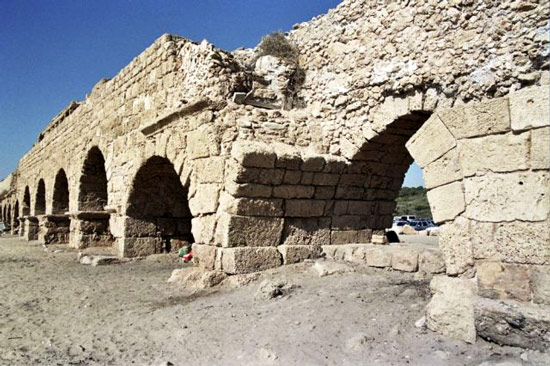
Sewell, Ian and Sewell, Wendy, “Aqueduct,” Encyclopædia Britannica Online, accessed March 15, 2019, https://www.britannica.com/technology/aqueduct-engineering.
Aqueducts are a system of structures like pipes, arches, ducts, and bridges that conduct a water stream across a hollow or valley. 1 Ancient Rome’s aqueducts delivered an estimated 1.5 million cubic yards of water per day—about 200 gallons per person. 2 The aqueducts transported drinking water, carried away sewage from the cities, and supplied the bath houses, crossing a distance from Spain to Syria. 3 4 The first Roman aqueduct was built in 312 B.C., and several more were built afterwards; the last one was in A.D. 226. 5 6 Currently, there is still one functional aqueduct that is still in use that was built in 19 B.C.
TIME, “Scientists Have Figured Out How Ancient Rome’s Concrete Structures Have Survived 2,000 Years | TIME,” YouTube video, 0:53, posted July 6, 2017, https://www.youtube.com/watch?v=tR-c3YSuYjE.
Another Roman artifact that is of great interest is Roman concrete. While concrete in itself is not very impressive, the resilience of Roman concrete against the test of time is mind blowing. While modern concrete structures break down in as little as 50 years, many Roman architecture are still standing today. The special recipe, only recently discovered and shown in the video linked above, involves seawater and volcanic ash, in addition to other substances like lime and rocks and is not only more strong against erosion, but also emits significantly less carbon dioxide in its production compared to modern concrete. 7 8
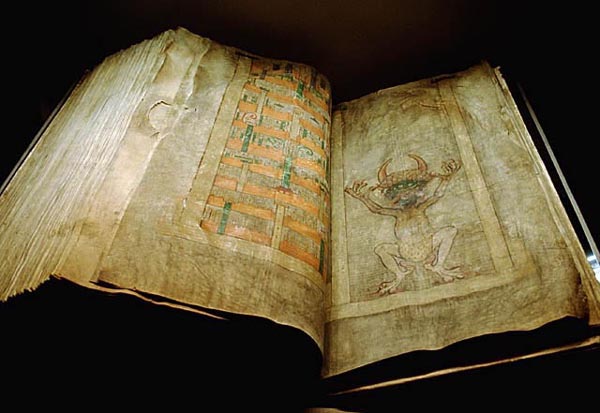
Kungl. Biblioteket – National Library of Sweden, “Codex Gigas,” 2005, http://www.kb.se/samlingarna/handskrifter/utlandska/.
Another Roman invention, the codex, is the first example of the books used today. The codex, a bound book with separate pages, replaced the scroll, and thus made the production and consumption of literature easier, benefitting writers, copyists, and readers during the time. 9 These three artifacts were such revolutionary ideas at the time, and they still amaze people in modern day! This is just a glimpse at the amazing history of Ancient Rome. I have much more to share, but that is all due to come in time as I discover Ancient Rome together with you, readers.
Footnotes:
1 Encyclopædia Britannica Online, “Aqueduct,” accessed March 15, 2019, https://www.britannica.com/technology/aqueduct-engineering.
2 Rodà, Isabel, “Aqueducts: Quenching Rome’s Thirst,” National Geographic, November 15, 2016, https://www.nationalgeographic.com/archaeology-and-history/magazine/2016/11-12/roman-aqueducts-engineering-innovation/.
3 “Roman Aqueducts, Aqueducts in Rome,” accessed March 16, 2019, https://www.rome.info/ancient/aqueducts/.
4 Rodà, “Aqueducts: Quenching Rome’s Thirst,” https://www.nationalgeographic.com/archaeology-and-history/magazine/2016/11-12/roman-aqueducts-engineering-innovation/.
5 Rodà, “Aqueducts: Quenching Rome’s Thirst,” https://www.nationalgeographic.com/archaeology-and-history/magazine/2016/11-12/roman-aqueducts-engineering-innovation/.
6 Rodà, “Aqueducts: Quenching Rome’s Thirst,” https://www.nationalgeographic.com/archaeology-and-history/magazine/2016/11-12/roman-aqueducts-engineering-innovation/.
7 Ahmad, Zahra, “Why Modern Mortar Crumbles, but Roman Concrete Lasts Millennia,” Science, July 26, 2017, https://www.sciencemag.org/news/2017/07/why-modern-mortar-crumbles-roman-concrete-lasts-millennia.
8 Jenkins, Aric, “Ancient Rome Concrete Mystery Solved by Scientists,” Time, July 05, 2017, http://time.com/4846153/ancient-rome-concrete-cement-seawater/.
9 Houston, Keith, “Culture – The Mysterious Ancient Origins of the Book,” BBC, August 22, 2016, http://www.bbc.com/culture/story/20160822-the-mysterious-ancient-origins-of-the-book.
Bibliography
Ahmad, Zahra, “Why Modern Mortar Crumbles, but Roman Concrete Lasts Millennia,” Science, July 26, 2017, https://www.sciencemag.org/news/2017/07/why-modern-mortar-crumbles-roman-concrete-lasts-millennia.
Houston, Keith, “Culture – The Mysterious Ancient Origins of the Book,” BBC, August 22, 2016, http://www.bbc.com/culture/story/20160822-the-mysterious-ancient-origins-of-the-book.
Jenkins, Aric, “Ancient Rome Concrete Mystery Solved by Scientists,” Time, July 05, 2017, http://time.com/4846153/ancient-rome-concrete-cement-seawater/.
Kungl. Biblioteket – National Library of Sweden. “Codex Gigas.” 2005. http://www.kb.se/samlingarna/handskrifter/utlandska/.
Rodà, Isabel. “Aqueducts: Quenching Rome’s Thirst,” National Geographic, November 15, 2016, https://www.nationalgeographic.com/archaeology-and-history/magazine/2016/11-12/roman-aqueducts-engineering-innovation/.
“Roman Aqueducts, Aqueducts in Rome,” accessed March 16, 2019, https://www.rome.info/ancient/aqueducts/.
TIME. “Scientists Have Figured Out How Ancient Rome’s Concrete Structures Have Survived 2,000 Years | TIME.” YouTube video, 0:53. Posted July 6, 2017. https://www.youtube.com/watch?v=tR-c3YSuYjE
Sewell, Ian and Sewell, Wendy, “Aqueduct,” Encyclopædia Britannica Online, accessed March 15, 2019, https://www.britannica.com/technology/aqueduct-engineering.


